Archive for the 'Me, me, me' Category
My schedule means I have virtually no time to do anything but work (including the commute) during the week, and increasingly the two days of weekend that I have tend to have an overflowing list of “stuff I’ve been wanting to do – often for quite a while – but can’t possibly do much of in the time I have this weekend”
I’ve got a minimum of two different podcasts/oggcasts that I can be working on (Episode 4 of “Stir-Fried Stochasticity”, regarding Tuberculosis and “heat-fixing” [and ninjas], should be ready to post soon. I also have plans to do an intermittent computer-nerd podcast, perhaps also to be submitted for “Hacker Public Radio“.) I have a bit of relatively minor but useful hardware-hacking to do (make a cable allowing me to plug an external microphone into my Android phone for potentially recording podcast/oggcast material and other things). I have work to do on www.dogphilosophy.net (which I plan to turn into the main podcast/oggcast distribution site). I have vague ideas of general creative endeavors that I could work on developing. I have a seemingly endless mass of domestic chores that could be attended to (it’s quite frightening to think of myself as “the neat one” in this house…).
It’s grotesquely hot outside as usual (why is it that no matter what part of the country I live in, the temperatures seem to spend most of their time 5-10°F above supposedly “normal” for the last decade or so? My hypothesis is that the universe dislikes me for some reason), so outdoor activities are currently lacking from my list.
I need one of those “life” things I keep hearing about. I’ve heard they’re kind of fun.
Any suggestions from anyone (anonymous or otherwise)?
P.S. Motorola corporation sucks. Thankfully it turns out HTC (unlike Motorola) actually knows what “geotagging” means…
Also P.S.: only one post and one off-blog comment letting me know the “Breakdancing Ghost of Narada Falls” post actually worked. Did anyone else listen to it (or try to and find they couldn’t)? If so, how did it sound? Thanks…

I’m still around, honest. Just got back from a semi-business trip involving way more sitting-in-a-car than is comfortable. I have a few pictures from the trip, which I’m working on getting uploaded to my Panoramio page. A few are up now, a few more will follow soon. See anything you like?
Meanwhile, I’m way behind on sleep. Good night, y’all. More in the next day or two…
I’ve been talking about it for months, now I’ve finally done it: I’m calling it “Pigsfly Pie”…and it’s awesome.
If you’ve not run into it before, there’s a classic Pennsylvania “Dutch” recipe called “Shoofly Pie“, which is more or less a dense molasses cake in a pie crust. It’s quite good…but I’ve improved on it. As the name implies the secret ingredient is the semi-official food of the Internet…Bacon.
Here’s the secret recipe:
Dry(ish) Stuff:
- About 155g all-purpose flour
- About 28g (2 Tablespoons) cold unsalted butter
- about 114g “dark brown” sugar
- about 300mg (around 1/8-1/4 tsp) salt
- about 10 slices of crunchy cooked bacon, finely chopped.
Wet(ish) stuff
- About 3/4 teaspoon (Google says this is about 3.6g) baking soda
- About 177g (3/4 cup) of boiling water
- About 128g (4.5 ounces) of Maple Syrup
- About 115g (about 4 ounces) Blackstrap Molasses
- About 5ml (1 tsp) vanilla extract
- One whole beaten egg
Oh, yeah, and:
- A 9″ radius pie crust
Processing:
- If you’re using a frozen pie crust, thaw it then poke holes in it with a fork and bake it at about 200°C (around 400°F) for about 10 minutes to prepare it for the wet filling.
- Mix all of the “dry” stuff besides the bacon together well – I actually used a potato masher to thoroughly mash together the butter/sugar/flour until it was homogenous. Then, take out about a quarter-cup worth of the mix and set it aside as a topping, then mix the chopped bacon into the rest. (edit 20100602 to remove the extra “until”…)
- Put the baking soda in a bowl, and pour the boiling water on it.
- Mix in the syrup, molasses, and vanilla, and stir well.
- Beat the egg, then carefully mix it vigorously in (hopefully the liquid will have cooled sufficiently that it won’t curdle)
- Quickly mix the main portion of the dry stuff with this wet stuff. Small chunks will be no big deal. The texture should be roughly similar to waffle or pancake batter.
- Pour this into the pie crust. A typical “deep dish” crust will leave some room left over. A “regular” pie crust will be filled to the top and leave you with a few tablespoons left over. Don’t worry about filling the crust to the very top – it tends to harden up as it expands so it doesn’t overflow in my experience.
- Sprinkle the about-a-quarter-cup of dry stuff that you saved over the top
- Bake 40-45 minutes at 175°C (about 350°F)
- Let it cool at least an hour before cutting
- Eat with an optional topping of whipped cream.
- Make ecstatic “MMMMmmmmmm” noises in appreciation of my culinary genius.
Next time I make it, I’ll probably use a deep-dish crust, then float pecan halves all over the top before sprinkling on the topping and baking…
All Hail Bacon!
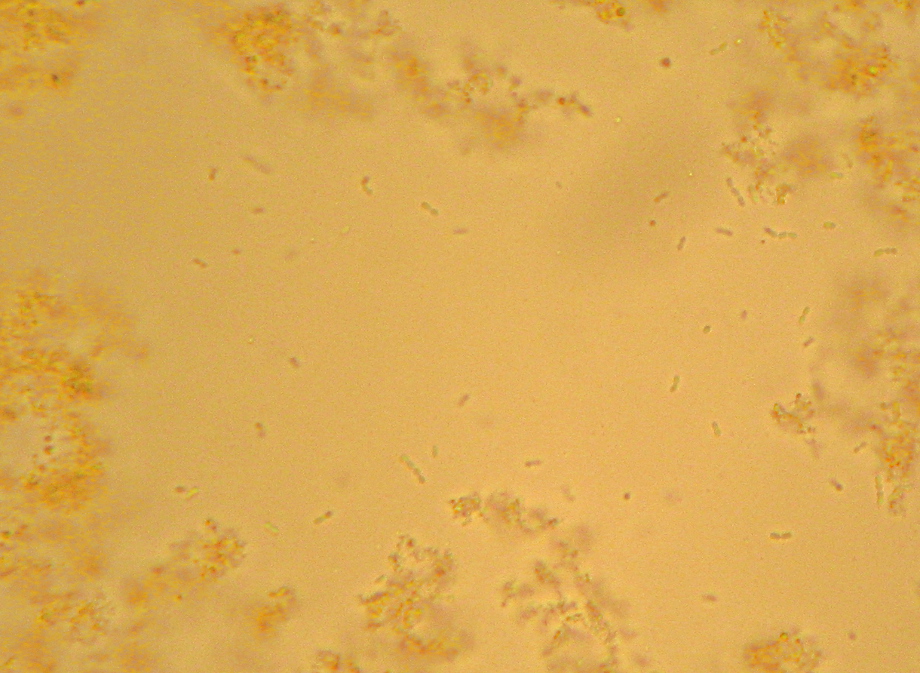
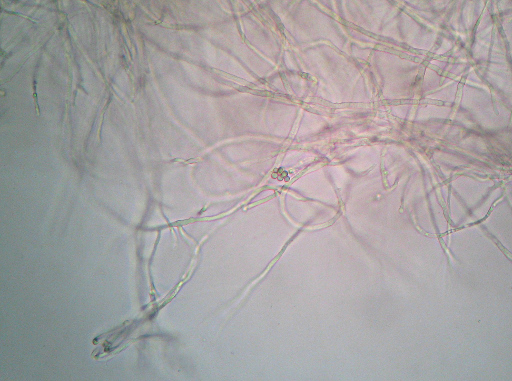
Intentional food microbiology:

UNintentional food microbiology:

I still don’t feel like I got nearly enough productive stuff done this weekend, but I did manage to do a bit of microscopy – plus demonstrating to myself that I still remember how to do a “Gram stain”. Real Post with explanation and more pictures to follow Real Soon Now…
I thought soap was supposed to be *clean*!
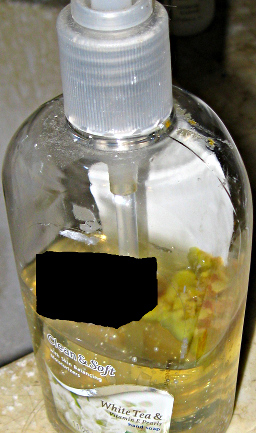
People usually assume soap gets rid of funky microbes that might grow on things, so I was very amused several months ago when I spotted something growing on top of the soap in one of the household hand-soap dispensers. As of today, it looks as pictured at left. That lumpy yellow and brown mass atop the the soap looked to me like some sort of soap-sodden mold, and have been saving the dispenser specifically in the hopes that someday I’d have a microscope and could take a look at it. Meanwhile, the mass spread, and slowly started releasing some kind of yellow pigment into the soap.
Incidentally, I kind of doubt this indicates some sort of failure on the part of the manufacturer of the soap. I don’t recall for certain, but I think I may have opened the dispenser at one point to transfer some of the soap to another nearly-empty dispenser. When the mass started growing originally, it was a single spot, which suggests a single spore or speck of dust floating in and landing on the surface. Hey, it happens. Anyway, I’ve therefore blanked out the name of the manufacturer since I don’t think they really have anything to do with this.
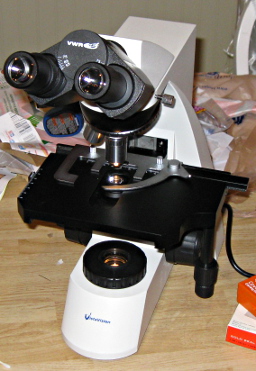
This mysterious growth upon my soap remained mysterious until today. Thanks to the Minister of Domestic Affairs and VWR (who managed to find me a really good deal), I finally got to actually get a close look at that lumpy mass. Meet my new friend Minnie (pictured at right). I could gaze into those eyes for hours. I couldn’t afford a darkfield condenser, and I sure as heck couldn’t afford to upgrade to phase-contrast gear, but I can add either one later if the opportunity presents itself. I also can’t afford the overpriced proprietary digital camera attachments either, though working around that is a whole other project. Until I identify an affordable model that plays well with Linux or work out how to modify a webcam into an ocular attachment,
I’ll have to settle for a trick…
It turns out if you take a digital camera and set it for close-up photos, you can actually stick the camera lens right up to the eyepiece and often get a serviceable picture.. Now, I had to subject the pictures I got today to moderately heavy processing to bring out the detail a bit better, but at least part of that is just me working on learning how to optimize the camera settings for this kind of use.
Equipped with some surplus slides and cover-slips donated by a kind professor who had some extra packages, I opened up the soap container and smeared a little of the yellow crud on a couple of them. One I just slapped a coverslip on for direct observation – the other I smeared over a slide and let dry with the intention of staining using the tiny, previously-unused vial of methylene blue left over from a very old plastic toy microscope. While the latter dried, I took a look at the wet mount hoping to finally see the mold mycelia that I had been expecting…
There wasn’t enough contrast to bother trying to get a photo, but it was obvious at 400x that what I was looking at was bacteria, not mold. Nerdly joy at learning something by looking in the microscope that I wouldn’t have otherwise known ensued, along with happiness as I realized this meant I had a perfect excuse to dig out my recent shipment from the Maker Shed – materials for doing a “Gram Stain”. Incidentally, the “Maker Shed” had the supplies on the way to me within hours of my ordering it, and they have lots and lots of cool stuff. I highly recommend it. Anyway, I got to do a “Gram Stain” for the first time in a couple of years (and the first time ever outside of a school lab). Want to see?
Mystery Microbe, I see you!
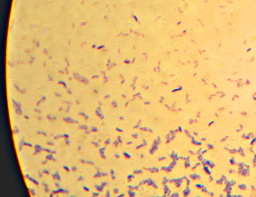
Here it is – the nasty yellow goo that infected my bottle of hand-soap. My staining technique was a little off since I’m out of practice – the way I interpret the results is that what I’ve got here is neither a member of the Firmicutes (i.e. “Gram positive”) nor – probably – Actinobacteria. I really can’t guess at more than that, though. I think the few “Gram-positive”-looking cells there are artifacts of insufficient decolorization. I know I still had a surplus of the purple “Crystal Violet” stain still on the slide at the end. (How did I know? I’ll show you at the end…). The irregular bluish bits towards the bottom are, I believe, just bits of stuff from the soap itself.
Meanwhile, this pretty much satisfies my curiousity about the Mystery Soap-Infecting Microbe. There’s certainly a lot more I could investigate, but my developing Hillbilly Biotech lab is really intended to support my interest in intentional food microbiology and perhaps evenutally some small-scale non-food industrial microbiology. I have some remaining curiousity about the yellow pigment and whether or not it might be useful for something, but I’m doubting there is any food or beverage I might want to grow this stuff in and therefore don’t have much use for it. Still, I’ll keep the bottle around for a while before I throw it out in case I think of something fun to do with it. If I end up being really interested in the identity of the bug growing on it, I should be able to find a liquid that I can grow a big mess of it in, then run it through a simple DNA extraction process. Then all I need to do is find someone who can supply PCR primers, a thermocycler, and sequencing services cheap. It might sound like I’m being facetious, but I wouldn’t be surprised these days if I manage to find somewhere that’d do it for $20/sample or less. I may eventually do this will the Mystery Soap Bug anyway, since I hope to be running through this process with cultures of sourdough, yogurt, cheese, vinegar, and brewing microbes that I develop myself. For now, though, it’s just nice to be playing with microbiology equipment again. And now fully independently! Wheeeeeeee!!!!!!
Yes, I’m a nerd. And proud of it!
What’s next?
Now that I finally have a microscope, I no longer have any excuse for not getting to work on the rest of my Hillbilly Biotech lab. Just this weekend I was pricing out Hillbilly Autoclaves. I picked up a cheap air pump and air stone
for potentially building an aerobic bubble-column fermenter (for quick growth of yeast starters or a working model of a “Fring’s Acetator®”-style vinegar generator. I still want to build an ozone generator for sanitization and to get a pH meter. I’d like to also get my hands on some wheat, barley, and rye seeds to sanitize, sprout, and grow here as the first stage of developing a truly local sourdough culture, plus arrange to have several pounds of plain flour irradiated to sterilize it.
I’m also like summer to be over. Yes, I’m writing this in Winter, but it’s not until later in the summer to autumn that locally-grown fruits will start becoming available, and locally grown fruits ought to be an ideal source of local brewing and baking yeasts and bacteria. Finally, I’d like to find a wealthy patron (or matron, I’m no sexist…) who would sponsor me so I could just pursue food-microbe bioprospecting and research full-time…
Oh, yes, and I need to get around to finishing Episode 4 of my little podcast project, especially since episode 4′s topic is a fundamental microbiology technique.
Comments welcome below – thanks for reading!
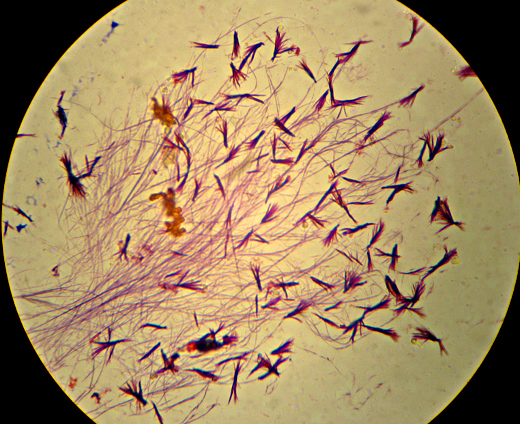
Oh, and as a reward for getting all the way to the end, here’s a picture that I thought was pretty – crystals of “Crystal Violet” and iodine. I told you I had too much left on the slide…
I’ve got two blog posts that I want to get done this weekend. This is one of them.
I’m something of a fan of MAKE magazine and its related websites and such, being a frustrated “Maker” and all. “Frustrated” because although I have a strong urge to make things, I seem to have a gross oversupply of chores and issues constantly popping up to keep me from getting much done. Still, I try, despite the efforts of the Dog and five (insert mild profanity here) cats (I seem to have been declared the household “Stuff that goes into and comes out of nonhuman mammal companions technician”), and living space that thinks it’s necessary to demonstrate how entropy works on a constant basis. MAKE’s slogan is “If you can’t open it, you don’t own it”, which I so passionately agree with that I wish they were a political party so I could vote for them.
Anyway…MAKE magazine recently posted a poll asking for opinions on the magazine, the website, and so on. The way the poll was structured didn’t really let me address what I really like and dislike about the site, so I thought I’d post it here in case anyone besides me is interested.
But first, some praise: part of the poll was asking about the online store they run – The Maker Shed. I filled in the poll just a day or so before I went and ordered something from it, so I couldn’t give any opinion of it at the time. Having now gotten what I ordered, I have to say the store seems to be moderately awesome.
One of my complaints about the MAKE franchise is that it often seems to be made entirely of Arduino™ electronics, Arts-and-crafts (e.g. knitted things), and baking-soda-volcano sorts of projects for children. In truth it’s not that bad, but I would personally like to see “less Arduino™, more ‘Bioreactor’” – they actually published a “Bio-hacking“-themed issue a while back, so there’s hope. I bring this up because what they had at the Maker Shed that I bought was microbiological staining supplies (not actually the kit pictured above, but they didn’t have pictures of individual bottles of what I got). I put in my order online expecting it to be shipped the next business day, and was pleasantly surprised to find an “okay, you’re order’s been shipped” notice in my email within an hour or two. The stuff even arrived by that weekend (i.e. today), hopefully leaving me time to use it for my planned second blog post of the weekend. So, definitely fast service at the Maker Shed.
There are a few annoyances I have with the MAKE franchise, though:
- Their “pod®casts” appear to all be videos (no audio-only podcasts at all)
I’d actually really like to have actual no-video-required audio shows that I could listen to on my 2½-hour daily commute. Not all of us want to (or can!) sit and stare at computer and/or “iPod®” video screens but still would like regular infusions of MAKE-related news and information.
- The videos appear to be all presented in proprietary Apple® formats or proprietary Flash on youtube.
This isn’t a major technical problem for me – Mplayer handles the files just fine. However, given that Apple’s preferred formats are all heavily patent-encumbered and proprietary and therefore not really legally usable for “making” video without special paid-for permission from Apple® corporation, it seems an odd choice for the “If you can’t open it you don’t own it” folks. Perhaps they’re just paranoid that Steve Jobs is lurking just on the other side of the bay, waiting for an excuse to come up there and kick their butts if they aren’t pro-Apple® enough? In any case, I’m kind of surprised they seem to have no interest at all in legally-free, amateur-multimedia-maker friendly formats like Vorbis and Theora.
- Where are the “Food and Drink” issues of MAKE?!?!? (And I don’t mean an Arduino®-controlled Lego® motorized model of a carnivorous cupcake or something, I mean actual edible food and potable brews. Not that “Killer Lego Robot Cupcake” wouldn’t be kind of neat….)
- There’s enough “kids stuff” to split off into its own publication
Or so I believe, anyway. They already split the arts-and-crafts stuff off into its own CRAFT magazine. If they also split off the “make a paper plate toy” stuff to “Make: Kids” (Wait, “making kids” sounds like some kind of pornographic euphemism. Make that “Kids: Make”) there’d be more room for the more hardcore stuff (and a higher chance of more stuff I’m personally interested in).
- It doesn’t seem like you can log in to comment on the Make blog without an account somewhere else (I USED to have a login directly on the site from when it first started, but that login no longer seems to work and the login screen implies the need to login through some other site’s service. Time to look up how to set up my own OpenID server…)
- The Maker Faire always seems like it’s awesome but I can never go.
This isn’t really MAKE’s fault, unless they’re part of the secret cabal that conspires to keep me from having enough wealth and leisure time to attend things like this.
- I can’t get this dang cat to quit jumping on my lap while I’m trying to type.
Okay, this has nothing to do with MAKE, but it’s annoying me right now.
There – now I’ve gotten it out of my system and out here where if anybody actually cares they can see it. Just some stuff that there was no way to convey in the survey. Otherwise I highly recommend MAKE magazine and its associated online material. The world needs more Makers and they’re doing some spiffy stuff to help in Sebastopol these days.
Now then, if all goes well I should have another post tomorrow with some pretty pictures of soap. Stay tuned…
(Oops, quick edit: the references on erythritol toxicity – or rather lack thereof – are now actually included…)
Crowds, Crass Commercialism, and Crappy Christmas Choruses give me a nasty case of Yule Poisoning, and I’m sure I’m not the only one.
I spent the afternoon/evening prepping for and performing some cookie experiments again, and I feel much better. Yes, my cookies are that good.
I had a request for Peanut Butter cookies, so I figured I’d do some experimenting with that tonight. In fact, while I was braving the Christmas Consumption Crowds to get my supplies, I happened upon an ingredient that I decided I had to try as a variant.
(The picture, incidentally, is someone ELSE’S peanut butter cookies – “diekatrin” on Flickr – click photo to go to the Flickr page – I still haven’t quite gotten the hang of getting decent photos of my own food yet.)
My initial peanut-butter cookie recipe came out too dry and not sweet enough, but I think adding 50-75g of honey should solve that. That’s not the most successful experiment of the evening though. That’s reserved for the following recipe for…Sunflowerseedbutter cookies.
(Suitably pompous name pending, as soon as I test version 2.0 of the recipe, which will substitute bread flour for the “all-purpose” flour)
(Pompous Name Pending) Sunflowerseedbutter Cookies
Materials and Methods
Powdery stuff
- 190g “All Purpose”(Around 1 cup) “All Purpose” Flour
- 3g NaHCO3 (1/2 tsp)
- 1-1.5g (1/4 tsp) “Baking Powder”
- 2g (1/4tsp) NaCl
- 750mg Xanthomonas campestris exopolysaccharide (~1/4 tsp “Xanthan Gum”)
“Wet” stuff and sugars:
- 150g honey
- 100g Erythritol
- 4g glycerol (about 5ml)
- 50ml double-strength black tea
- 140g Sunflower Seed Butter (about 1/2c)
- 60g unsalted butter
- Contents of 1 Gallus gallus egg, 50-55g (approx 60g with shell… aka “large”)
- 5ml Vanilla Extract
The “dry” goods were mixed in one container, while in a separate container, the “wet” goods and the sugars were mixed in another. The dry material was then blended carefully into the wet material in a large steel mixing bowl using an electric hand-held mixer until completely homogenized.
Once homogenized, the dough was spread out in the bowl and chilled at ~18°C(O°F) for approximately five minutes to enhance firmness.
The dough was then measured onto a “non-stick” baking sheet in approximately 30ml roughly-hemispherical aliquots using a small disher, and then pressed down with a fork to approximately half their original height. A few shelled, roasted sunflower seeds were pressed into the surface of each to make distinguishing them from peanutbutter cookies easier.
The cookies were than baked at 190°C (~375°F) for approximately 18 minutes, then slid onto a “non-stick” wire cooling rack at Standard Temperature and Pressure until equilibrated with the temperature of the kitchen.
Results:
The experimenter believes this batch of cookies emerged a bit too soft – actually sliding them off of the baking sheet to the rack distorted them, and they still appeared (in the words of the experimenter) “squishy”. Once equilibrated with room temperature, the cookies had a texture more in line with what would be expected from a normal “soft cookie”. The flavor was judged to be superb by the experimenter, who happens to like the flavor of sunflower seeds.
Discussion:
The use of erythritol makes this a “reduced calorie” and “reduced-sugar” recipe, though not entirely sugarless or “diabetic safe” necessarily, due to the use of honey. Erythritol is a sugar alcohol like sorbitol, mannitol, xylitol, or glycerol (“glycerine”), all of which are often used as low-glycemic substitutes for sucrose or other sugars. Sugar alcohols can often cause digestive discomfort, however, because they are poorly absorbed by human digestive tracts, leaving them to be digested by gas-producing gut microbes. Erythritol is unique in that it appears to be well-absorbed by humans, and yet is not metabolized by humans to any substantial degree and is safely filtered out by the kidneys and excreted in urine[1]. Being unmetabilized by humans, it is theoretically “zero calorie”, though the US FDA mandates a calculation of 0.2 calories per gram (compare to 4 calories per gram for sucrose). Unlike xylitol, erythritol is also safe for dogs[2] and ferrets[Sorry, can't find the citation for this one at the moment...], for whom xylitol can induce fatal insulin shock and/or liver damage. Erythritol, unlike glycerol or sucrose (“table sugar”), is not appreciably hygroscopic, though, so adjustments must be made to recipes using it to avoid an overly dry result.
Glycerol (sold as “Glycerine”, which can be found in cake-making supplies as an ingredient used to keep cake frosting moist) closely resembles erythritol in structure, being (to oversimplify) a one-carbon-shorter version of the same molecule. In addition to hopefully helping to prevent drying out of the cookies, this was included here in the hopes that it would also help the erythritol dissolve. Previous informal testing (unpublished results) appears to support this hypothesis.
Honey was used as a second sweetener so as to include a “real” sugar and to help counter-balance the lack of hygroscopicity of the erythritol. The experimenter also notes that he believes mixing sweeteners tends to provide a better-tasting sweetness than relying entirely on one sweetener, particularly when including less sweet “sugar substitutes” in the mix. Honey was also chosen to provide additional moisture, as a previous batch of peanut-butter cookies (the recipe from which this recipe for sunflower-seed butter is derived) using ordinary sugar and “brown sugar” had turned out excessively dry.
“Xanthan gum” is a polysaccharide (as are cornstarch and pectin, for example) produced by a natural fermentation process from the γ-Proteobacterium Xanthomonas campestris. Along with a wide variety of exotic industrial uses (such as oil-well drilling “mud”), Xanthan gum is also used as a safe food ingredient to help hold water and keep soft foods from being too runny. It helps protect ice-cream from becoming grainy during possibly partial thaw-and-refreeze cycles during shipping and storage. It’s also used to hold “gluten-free” doughs together, which is nice for people who may be allergic to gluten proteins but who still would like to eat bread…
As far as the potentially excessive softness of the cookie, the experimenter believes that substituting bread flour for “all-purpose” flour and baking for up to 20 minutes should solve the softness problem, resulting in a chewier texture which the experimenter believes will be more appropriate.
The experimenter also notes that a second batch of the same recipe, cooked for approximately 20 minutes at ~205°C (~400°F) were nearly burned, though they did come out firmer but drier in texture. The flavor was still judged superb, other than the slight burnt note. Subsequent versions of this recipe will revert back to the original 190°C cooking temperature.
Obviously, further research is needed to determine the correct modifications to achieve perfect texture, and of course, to broaden the sample size of of the taste-testing group, and the experimenter should be given a sizable grant and a nobel prize for this research. Well, a grant at least.
Or at least some praise or something. Or a cookie, except that the experimenter obviously already has some.
[1] Munro IC, Berndt WO, Borzelleca JF, Flamm G, Lynch BS, Kennepohl E, Bär EA, Modderman J:”Erythritol: an interpretive summary of biochemical, metabolic, toxicological and clinical data.”;Food Chem Toxicol. 1998 Dec;36(12):1139-74.
[2]Dean I, Jackson F, Greenough RJ:”Chronic (1-year) oral toxicity study of erythritol in dogs.”;Regul Toxicol Pharmacol. 1996 Oct;24(2 Pt 2):S254-60.
Dangit, I’m out of time. I was going to try out some crazy ideas with my Ginger Cookie recipe, too, and see if I can develop a Kombucha culture from scratch. Guess that’ll have to wait, because it’s bedtime now. Back to work in the morning…
Looks like the truckloads of candy-seeking larvae are done finally. Wretched little urchins now get driven from block to block rather than walking the neighborhood like we did.
(It doesn’t actually bother me as much as that makes it sound, I just like having an excuse to say “wretched little urchins”…which reminds me – I have only about a month to get a cheerful flashing “Bah! Humbug!” sign built…)
The only thing that really annoyed me is the fact that having to be ready to be interrupted by another horde of costumed consumers meant I couldn’t really spend any of the evening getting into anything requiring any real attention…which means the 113g of CaCl2.2H2O I’ve got sitting here now to go with my Xanthan Gum has been left neglected, and I still don’t know if I can make Xanthan Gum gel into beads the way you can with sodium alginate. I figure it must be possible, given that both Xanthan gum and Alginate (among others) were all formed into little “bio-booger” beads using the same kind of process in the paper I discussed in Episode 2 of my little audio oggcast. Perhaps I’ll have time to find out tomorrow.
For now, it’s time for bed. Daylight Losings Time starts tonight, so if the critters allow me to actually sleep, I ought to be well rested to attempt some serious lake-spanking in the morning – there’s supposedly a resort on the shore of the lake that has a sushi bar, and the idea of being able to paddle out for sushi amuses me. It looks like it’s at least 9-10 miles away, though, so it’ll be a long trip if I attempt it. Hopefully I’ll have time left after that.
Also, the developer of the libdmtx datamatrix barcode encoder and decoder software posted a recent comment on my previous post about the software and its potential uses – looks like some interesting projects going on there, including one intended to generate ID cards that only legitimate authorities could read (so as to prevent identity theft).
P.S. Anybody know how to build a really good (but simple) ozone generator for sanitization purposes? Or the effective pore sizes of commonly available materials like plastic wrap? Or if a corporate entity can be a shareholder/partner in a Limited Liability Company?
Yes, I’m still here – though I don’t know if any of YOU are.
The pay at my job is somewhat low for the skillset it requires, but makes up for that by having a very reasonable workload, a pleasant work environment, and certain perks – like access to the electronic journals that my employer subscribes to. I added an RSS feed from pubmed intended to cover my main interests – basically edible and industrial microbiology and biotechnology. Every day, a list of 300-600 or so new scientific articles pops up in my feedreader and I scan through the titles looking for anything interesting to me. Unintentionally, my selection appears to also result in quite a bit of diabetes, obesity, and sports medicine research. Lately I’ve taken a moderate interest in our own most blatantly bacterial components, the mitochondria.
Mitochondria are kind of like a nearly 2-billion-year-long case of typhus (or Rocky Mountain Spotted Fever, if you prefer). After infecting our ancestors (and now us) for so long, they’ve been reduced to dependency on living in our cells. Perhaps a bit like the progression from wolves to Chinese Crested dogs. On the other hand, having thoroughly domesticated them, we get a lot of use out of them, and couldn’t live without them. Their ability to harness the electron-sucking power of oxygen means we get almost 20 times more energy out of our food than we otherwise would, which is a good thing since biologically speaking, keeping the hideously complicated mess of biochemistry that makes up a human body takes a ridiculous amount of biochemical energy compared to that of normal organisms (i.e. prokaryotes).
Lately in the stream of new publications I’ve been seeing a number of papers suggesting that a lack of proper mitochondrial activity might be related to obesity and related problems (e.g. “metabolic syndrome”, type 2 diabetes and insulin resistance, obesity-related “inflammation”, and so on) and even some age-related problems, both physical and mental. There is some seriously interesting research going on into treatments to potentially stimulate mitochondrial activity and whether this might help solve a number of health problems.
So…take good care of your mitochondria. For the past couple of weeks I’ve been trying to pay special attention to properly feeding my mitochondria and making sure I take them for regular walks (and paddling trips and so on). It could, of course, be purely psychosomatic, but right now I feel better than James Brown…
There’s a fair amount of rational skepticism over using drugs or nutritional supplements to stimulate mitochondria, but here’s a tip that I suspect everyone’s doctor would accept: make sure you take your mitochondria for regular walks. Frequent exercise (particularly endurance exercise) seems to be a scientifically well-accepted way to induce production of more mitochondria.
But now I have to go to bed. My main complaint with work these days is that it eats up essentially my entire day, leaving me with just enough time for some household chores between getting up in the morning and going to bed in the evening. Not their fault I live almost and hour and a half from work, though (and at least the commute is through relatively low-traffic and scenic terrain.). Still, it makes it hard to get blog posts and podcasts done (episode 4, on the subject of “heat-fixing” of bacteria for microscopy – particularly Mycobacterium tuberculosis – will be out as soon as I can manage. Still pondering the subject of Episode 5. I’m saving the “Two Mass Spectrometers, High Performance Liquid Chromatography, and a Female Donkey” episode for later when I manage to surpass the “nearly 3″ listeners that I seem to be stuck at…)
I’m still not sure I know why I have a desire to push recordings of my voice onto a more or less innocent worldwide population, but I do. And now I have a real theme to wrap an attempt at a podcast (or as I prefer – “oggcast”) around: scientific papers.
I finally got annoyed at press-release-based science stories one too many times, and thought to myself “why does almost nobody who does these stories at least cite the dang thing so I can go look it up and see what’s really in it, if they can’t be bothered to actually read and report on it themselves rather than just the press-release?” The story in question was the recent one about how babies understand dog-language (or something like that). Since I consider the dog to be a philosophical role-model, I wanted to read the actual paper and see if it was as silly as the headlines made it sound or (as I suspected) less flashy but more solid…but even “Science Daily” didn’t cite it.
Finally talking myself out of putting off doing audio recording, I tracked down the original paper, read it, and whipped out a rough show discussing what I found in the paper. I had fun doing it, so I’d like to turn it into a series.
I’ve put up a utilitarian page at http://bigroom.org/stirfry with both a built-in <audio> tag interface and direct-download links for both Ogg Vorbis and MP3 versions.
I’m still deciding exactly how I’m going to decide on the papers to cover – should I pick obscure, forgotten ones that almost nobody else would ever read again without me stumbling on them and talking about them? Classic papers? Papers related to recent news stories like this one? All of the above? Depending on how long I end up trying to make the episodes, perhaps starting with some kind of scientific question and then reporting on a selection of papers I dig up to address the question, or just a selection of papers on the same subject? I’ve already gotten a request for an episode on the theme of prokaryotic extracellular polysaccharides…
The rate at which I can convince myself to try to crank these out (and improve their quality) is directly proportional to how much interest there might be out there in them, so please don’t hesitate to let me know if you think this might be interesting. Please don’t let me slack off! Also, feel free to correct me if I’m wrong about anything I mention in the show or the attached show notes.
If you don’t want to comment here, you can also email me at epicanis at bigroom.org.
Thank you, and good night…
Next »